
Connecticut Bail Guide • Updated 2026
How Bail Bonds Work in Connecticut. A Simple, Step-by-Step Guide.
Understanding how bail bonds work can make a stressful night much easier. This guide explains, in plain English, how bail works in Connecticut, what a bail bond costs, what a co-signer agrees to and what happens from the moment of arrest until the case ends and the bond is discharged.
- Plain-English answers
- Connecticut-specific rules
- Licensed agents 24/7
The Short Answer
How Do Bail Bonds Work?
Bail bonds work by having a licensed bail bond agent post a surety bond for the full bail amount, so the defendant can be released from custody while promising the court they will attend every hearing. You pay the agent a non-refundable premium, set in Connecticut at a state-approved rate, instead of paying the full bail yourself.
If the defendant attends every court date and follows every condition, the bond is discharged when the case ends. If they miss court, the bond can be forfeited and the bail bond company, and possibly the co-signer, becomes responsible for the full amount. That is the basic idea behind how bail bonds work everywhere, but Connecticut has its own rules on pricing, payment plans and the court process, which this guide explains below. That is how bail bonds work for most families.
Release Options
What Is Bail in Connecticut?
Bail is the security a court or police department requires to make sure a defendant returns to court. In Connecticut, a person may be released in several ways, and a bail bond is only one of them. Knowing the options is the first step to understanding how bail bonds work and when you actually need one.
Written Promise to Appear
The defendant is released after signing a promise to come to court. No money is required, and no bail bond is needed.
Non-Surety Bond
The defendant signs a bond promising to pay a set amount if they fail to appear, but pays nothing up front.
Cash Bail
The full bail amount is deposited in cash. It is generally returned when the case ends, as long as every condition is met.
Percentage Cash Option
For many surety bonds up to $50,000, Connecticut court rules allow a cash deposit of a percentage of the bond instead of the full amount, unless a judge orders otherwise.
Surety Bond (Bail Bond)
A licensed bail bond agent guarantees the full amount to the court in exchange for a premium. This is what most people mean by a bail bond.
Held Without Bail
In rare, very serious cases, a judge may order a defendant held without bail. No bond can be posted in that situation.
You can read the Connecticut court rule on percentage cash bail in the Connecticut Practice Book, and the bail bond laws in Chapter 700f of the Connecticut General Statutes.
The Process
How Bail Bonds Work: The Process Step by Step
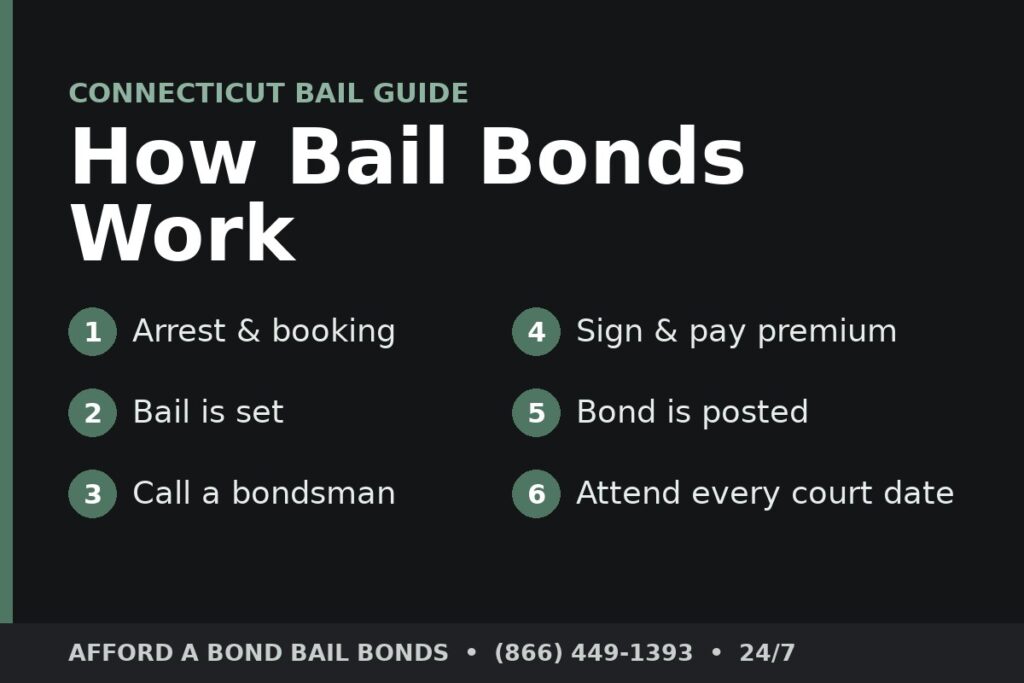
Here is exactly how bail bonds work in Connecticut, from the moment of arrest to the end of the case.
1
Arrest and Booking
After an arrest, the person is taken to the police department or State Police troop for fingerprints, photographs and paperwork. Police check for warrants and decide whether the person can be released.
2
Bail Is Set
Police may release the person on a promise to appear or set a bond at the station. If not, a judge sets bail at arraignment, usually the next business day, after Pretrial Services of the Court Support Services Division reviews the case.
3
You Contact a Bail Bondsman
Call a licensed bail bond agent with the defendant’s full name, date of birth, where they are held and the bail amount if you know it. The agent confirms the details with the facility.
4
Application and Co-Signer
You and any co-signer complete a short application and bond agreement, usually by phone and e-signature. The agent explains the premium, any payment plan and any collateral.
5
Pay the Premium
You pay the state-approved premium, or the required down payment on a payment plan. This is the fee for the bond and is not refunded.
6
The Bond Is Posted
The agent posts the surety bond with the police department, court or correctional facility, which then completes its release process. That can take from minutes to several hours.
7
Court Dates and Discharge
The defendant attends every court date and follows every condition. When the case ends, the bond is discharged and any collateral is returned.
Setting Bail
Who Sets Bail and How Is the Amount Decided?
In Connecticut, bail can be set by the police at the station or by a judge in Superior Court. When a judge sets bail, Connecticut law directs the court to consider factors that show how likely the defendant is to return to court and whether release poses a risk to others, including:
- The nature and seriousness of the charges
- The defendant’s criminal record and history of appearing in court
- Family ties, employment and length of residence in the community
- The weight of the evidence in the case
- Any risk to the safety of another person
- The defendant’s financial resources
A defense attorney can ask the court to lower bail or change the conditions at arraignment or later. If bail is reduced, the premium is recalculated on the new amount, which is another reason understanding how bail bonds work helps families make good decisions.
Who Is Involved in a Bail Bond?
Defendant: the person who was arrested and must attend court.
Co-signer (indemnitor): the family member or friend who signs the bond agreement.
Bail bond agent: the licensed professional who writes and posts the bond.
Surety company: the insurance company that backs the bond.
Court and Pretrial Services: they set bail, conditions and court dates.
Cost
How Much Does a Bail Bond Cost in Connecticut?
Bail bond premiums in Connecticut are regulated. Every licensed agent must charge the premium rate approved by the Connecticut Insurance Department, and agents certify each month that every bond was written at that rate. The standard structure is 10% of the first $5,000 of the bond plus 7% of any amount above $5,000.
If you cannot pay the full premium at once, a payment plan is possible. Connecticut requires a down payment of at least 35% of the premium, with the balance paid under a signed written agreement. Larger bonds may also require collateral, such as real estate equity or a vehicle title.
There is no legal way to get a bail bond for less than the approved rate, so be cautious of any offer that sounds too good to be true. Knowing how bail bonds work in Connecticut protects you from unlicensed operators.
Estimated Premiums
| Bail amount | Est. premium | Min. down (35%) |
|---|---|---|
| $1,000 | $100 | $35 |
| $5,000 | $500 | $175 |
| $10,000 | $850 | $298 |
| $25,000 | $1,900 | $665 |
| $50,000 | $3,650 | $1,278 |
| $100,000 | $7,150 | $2,503 |
Estimates only. Your final premium is the rate on file for our surety, and payment plans are subject to approval.
Compare Your Options
Cash Bail vs. Bail Bond: What Is the Difference?
Many families wonder whether to pay cash or use a bail bond. Here is how the two options compare, and how bail bonds work differently from cash bail.
| Cash Bail | Bail Bond | |
|---|---|---|
| Amount paid | The full bail amount | The premium only |
| Refundable? | Generally yes, at the end of the case, if all conditions are met | No, the premium is the fee for the bond |
| Effect on savings | Ties up the full amount for the length of the case | Keeps most of your savings available |
| Who guarantees the bail | You | A licensed agent and surety company |
| Help with the process | You handle it yourself | The agent explains the process and posts the bond |
Families often choose a bail bond when the bail amount is more than they can comfortably set aside for the months a case can take. Others pay cash when the amount is small and they want it back at the end of the case.
Co-Signers
What Does a Co-Signer Agree To?
Most bail bonds need a co-signer, also called an indemnitor. Co-signing is a serious commitment, and a big part of understanding how bail bonds work is knowing what the co-signer is responsible for. Before you sign, a reputable agent will walk you through every term.
A good co-signer is a family member or friend with a valid photo ID, a stable address and steady income, who feels comfortable helping the defendant stay on track. If you have concerns about the defendant’s reliability, talk them through with the agent before signing.
A Co-Signer Typically Agrees To
- Help make sure the defendant attends every court date
- Pay any remaining premium under a payment plan
- Possibly cover the full bond if the defendant does not return
- Pledge collateral if the bond requires it
- Keep the bail bond agent informed of any changes
Conditions
Common Conditions of Release
Conditions are a key part of how bail bonds work. Courts can attach them to any release. Breaking a condition can lead to a new arrest and revocation of the bond, so the defendant should understand each one before leaving custody.
- No-contact or protective orders
- Travel limits or passport surrender
- Curfews or GPS monitoring
- Drug or alcohol testing and treatment
- Regular check-ins with the Court Support Services Division
- Surrender of firearms and permits
Missed Court
What If the Defendant Misses Court?
Missing a court date is the most serious problem in any bail bond. The judge can order the bond forfeited and issue a rearrest warrant. In Connecticut, missing court on a felony case can lead to a charge of failure to appear in the first degree, a class D felony, and missing court on a misdemeanor case can lead to failure to appear in the second degree, a class A misdemeanor.
The co-signer may also become responsible for the bond. The best step is to act immediately: call the bail bond agent and a defense attorney, gather any proof of why court was missed and plan a voluntary surrender. Quick action often makes it possible to get the case back on track.
When Does a Bail Bond End?
The final step in how bail bonds work is discharge. A bail bond ends, or is discharged, when the case is resolved, whether through dismissal, a not guilty verdict or a plea and sentencing, or when the court releases the bond for another reason. Once the bond is discharged, the co-signer’s responsibility ends. The premium is not refunded, but any collateral must be returned, and Connecticut rules require collateral to be returned within 21 days after the agent learns the bond has been terminated.
Real-World Situations
How Bail Bonds Work in Common Situations
The basics are the same for every case, but how bail bonds work can change slightly depending on the situation. Here are the situations Connecticut families ask us about most often.
Weekend and Night Arrests
If bail is set at the police station, the bond can often be posted right away, even at night. If the person must see a judge, they usually wait for the next court session.
Active Warrants
With a warrant, the bail amount is usually known in advance, so you can arrange the bond before the person turns themselves in and release can happen the same day.
Family Violence Cases
The defendant must see a judge at the next court session, and protective orders are common. How bail bonds work here is the same, but the conditions are stricter.
Families Out of State
Co-signers do not need to be in Connecticut. Paperwork can be completed by phone and e-signature, and the agent posts the bond locally.
Large Bonds
For bonds of $100,000 or more, the agent may ask for additional co-signers or collateral. The premium still follows the same Connecticut formula.
Probation Violations
When bail is set on a violation of probation, how bail bonds work does not change, but there may be two bonds if there is also a new charge.
Whatever the situation, the easiest way to see how bail bonds work for your case is to call a licensed agent. We explain every step, confirm the bail amount and tell you exactly what to expect before you sign anything.
FAQ
How Bail Bonds Work: Frequently Asked Questions
How do bail bonds work in simple terms?
You pay a licensed bail bond agent a premium, and the agent guarantees the full bail amount to the court so the defendant can be released. The defendant must attend every court date until the case ends. That is how bail bonds work in every Connecticut case.
Do I get my money back from a bail bond?
No. The premium is the fee for the bond and is not refunded. Collateral, if any, is returned once the bond is discharged and all obligations are met.
How much is a bail bond in Connecticut?
The standard premium is 10% of the first $5,000 of the bond plus 7% of the rest, at the rate approved by the Connecticut Insurance Department. A $10,000 bond costs $850 and a $50,000 bond costs $3,650.
How long does it take to get out of jail after a bail bond is posted?
Release from a police station is often quick, while release from a Department of Correction facility can take several hours, depending on processing and shift changes.
Can I get a bail bond with no money down?
No. Connecticut law requires a down payment of at least 35% of the premium when the premium is financed, and agents must charge the state-approved rate.
Do I need collateral for a bail bond?
Not always. Many bonds are approved with a co-signer and a payment plan. Larger bonds or higher-risk cases may require collateral such as real estate or a vehicle title.
Can bail be posted at night or on weekends?
Yes. Afford A Bond Bail Bonds answers 24 hours a day, 7 days a week. Bonds set at police stations can often be posted at night, while some cases must wait for a judge at the next court session.
Is a bail bondsman the same as a bail bond agent?
Yes. In Connecticut, the licensed term is surety bail bond agent, and every agent must be licensed by the Connecticut Insurance Department.
What happens to the bond if the charges are dismissed?
When the charges are dismissed and the case ends, the bond is discharged and the co-signer’s responsibility ends. The premium is not refunded because the bond already served its purpose.
Can a bail bond be revoked?
Yes. A court can revoke a bond if the defendant violates release conditions or is arrested on a new charge, and a bail bond agent may surrender a defendant who poses a serious risk of not appearing in court.
Connecticut Law
Connecticut Bail Laws and Official Sources
Everything in this guide follows the Connecticut General Statutes (CGS). These are the sections that control how bail is set and what a bail bond agent may charge. Each link opens the official or full text, so you can check the rules yourself.
| CGS § 54-63c | Release by police after an arrest: a written promise to appear or a bond set at the station. | ||||||||||
| CGS § 54-64a | Release by the court at arraignment. For misdemeanor-only charges, the court may not set money bail unless the charge is family violence, the defendant asks for it, or the court finds a likely risk on the record. | ||||||||||
| CGS §§ 38a-660 to 38a-660m | Surety bail bond agents are licensed by the Connecticut Insurance Department and appointed by an insurer. | ||||||||||
| CGS § 38a-660b | An agent must charge the premium rate approved by the Insurance Commissioner, and certify it every month. | ||||||||||
| CGS § 38a-660c | Payment plans need a down payment of at least 35% of the premium, with the balance due within 15 months. | ||||||||||
| CGS §§ 29-144 to 29-152 | Professional bondsmen are licensed by the State Police (DESPP). § 29-151 caps their fees at 10% of the first $5,000 and 7% of the rest. |
See all 18 Connecticut courts and the towns each one serves on our Connecticut court locations page, and where people are held on our Connecticut jails page. Court locations come from the Connecticut Division of Criminal Justice, and court dates and case details can be checked on the Connecticut Judicial Branch website. This guide is general information, not legal advice. For advice on a specific case, speak with a Connecticut criminal defense attorney.
Keep Reading
Related Bail Bond Resources
Learn more about how bail bonds work for specific charges and locations:
Still Have Questions About Bail?
A licensed Connecticut bail agent can explain how bail bonds work for your exact situation, day or night, with no obligation.